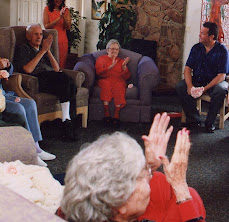
This blog will be a place to post poetry written by people living with Alzheimer's disease. We will focus on poetry that is created as part of the Alzheimer's Poetry Project. We will post information and news about dementia. We hope this blog is of use to the family members who have a loved one with dementia.

Wednesday, August 18, 2010

"I wandered lonely as a cloud": Lyric Selfhood and Alzheimer's


Susan Schultz has written a wonderful review of Sparking Memories: The Alzheimer's Poetry Project Anthology on her Tinfish Editor's Blog.

Schultz takes a paper by, Steven Sabat and Rom Harre, "The Construction and Deconstruction of Self in Alzheimer's Disease," as her starting place to look at the "I" in romantic poetry and how that relates to self of the person living with dementia.

I find Schultz' take on the poems we use in the APP fascinating and I am thankful to have this new way to look at the work we are doing through the concept of Deconstruction.

And then my heart with pleasure fills,
And dances with the daffodils.

And then my heart with pleasure fills,
And dances with the daffodils.

And then my heart with pleasure fills,
And dances with the daffodils.

Saturday, August 14, 2010

A Report from the Field


We are thankful and proud to have had Helen Wilson as one of our summer interns.
She is studying with Professor Philip Davis at the University of Liverpool. Davis is famous for among other accomplishments his work on the Shakespeared-Brain. An amazing study that shows the brain's response to the use of the grammatical technique of the "functional shift."

We believe the principle explored in Davis' research can be extrapolated to other poetic techniques such as metaphor, simile, and image and accounts in part for the powerful response we see in people living with Alzheimer's disease to poetry. That is the anecdotal observations we see as increased facial expression, smiling, and verbal social engagement are tied to the increase in synaptic activity shown when the brain encounters this creative and unusual use of language.


Here is Helen's account of participating in the Alzheimer's Poetry Project this summer.


Everyday buses lurch, the subway rattles on its tracks and cars jam against one another in the throbbing heat of the summer commute. New York is undeniably a place movement, desirable for some, unavoidable for others. There are those, however, for which the heavy pace of the day to day passes them by entirely; office chairs are replaced with recliners, computer screens with that of the television and the heavy noise that otherwise rims this city with a quiet broken perhaps only by the assertions of an overhead speaker.

A dreary life? No, not necessarily. One different to that generally recognized as ‘New York’? Certainly. The inhabitants of Amber Court Residential Home are such as this. With a population of elderly residents at differing stages of the condition Alzheimer’s, this is not a group I anticipate as one of lively interaction and enthusiastic engagement. This is set to change.

When asked to read Shakespeare’s Sonnet 18 to the group my first reaction is one of apprehension, reading poetry aloud being something I have never felt entirely comfortable with; partly the remains of shyer younger years and partly a reluctance to share that which sits closest to my heart with a public audience. A previously fumbled reading has left me a little more apprehensive than normal and today I am especially glad of Gary’s optimistic and energetic introductions.

We begin the session and the apparent simplicity of the first poem’s first line ‘Pan es Pan’ belies its power in waking up this audience; previously bent heads begin to rise, formally stilled mouths move along in time and there really is no better way to understand this ditcho than by the smiles that start to appear around the room on its conclusion. In a later session, one resident, apparently disengaged from the entire activity, is roused from his silence with careful questioning, to the point where, reluctant to be held back from participation any longer, he takes the sheet to read the poem aloud himself. We later learn that such an outcome was beyond the imaginings of those caring for this man.

The irrepressible spirit of a woman in her eighties is communicated when she spontaneously delivers a saucy alternative to The Purple Cow", a move that has much of the room laughing with her by the end. The mood transforms from one of at best sedate, at worst dull, to one of play and mischief, I guess what one might call ‘fun’; not something instantly associated with elderly care.

Once the interest of the group is sparked, and the focus maintained, I am introduced and take my place in front of this now receptive crowd. On beginning to read I realize that what I am keenest to communicate is not the clarity of the words as such, but what they strive to find; the feeling, or truth, beneath. It is in looking into the faces of those so different to mine that the line ‘And thy eternal summer shall not fade’ takes on a new resonance; the context of age and decline becomes an asset rather than a hindrance, as that celebrated in the vital insistence of these words – the eternality of shared human experience that goes beyond the individual human life – begins to voice itself afresh.

It is in this moment that I cannot help but realize that in keeping poetry ‘to myself’, in surreptitious private readings has been, for so many years, to miss the point entirely, as it is only in sharing the contents of one heart that we can hope to move others. This was not perhaps what I expected to learn from this internship, thinking myself there to bring the residents out from the shell of their condition, rather than to move out from underneath my own. A better and more valuable lesson would have been hard to come by; as those sleeping minds reawakened to Shakespeare’s distilled and eternal truth, so did mine in a mutual understanding that overcame illness, cultural difference and age. The capacity for literature to bring us all back to the real nature of shared life, so easily forgotten in traffic jams or breakfast queues, is something that the Alzheimer’s Poetry Project is proving impossible to deny.

SONNET 18

Shall I compare thee to a summer's day?
Thou art more lovely and more temperate:
Rough winds do shake the darling buds of May,
And summer's lease hath all too short a date:
Sometime too hot the eye of heaven shines,
And often is his gold complexion dimm'd;
And every fair from fair sometime declines,
By chance or nature's changing course untrimm'd;
But thy eternal summer shall not fade
Nor lose possession of that fair thou owest;
Nor shall Death brag thou wander'st in his shade,
When in eternal lines to time thou growest:
So long as men can breathe or eyes can see,
So long lives this and this gives life to thee.

Ever wonder what Shakespeare really looked like? Check out this article from last March on the Cobbe painting of Shakespeare.

Thursday, July 29, 2010

Tree Poem


This poem was created by the Mindmovers, early stage group at N.E.W. Curative Rehabilitation in Green Bay, Wisconsin. Executive Director, Noreen Greatens and Program Director, Bob Kralapp of Legacies Arts Project Inc., were receiving training as part of our affiliate program.

The poem was created by asking simple questions about trees. What is your favorite? What a person might do in a tree? What animals might you find there? The answers are in order given with care taken to get the language as close to the words the person says when answering and with only light editing.

The discussion and answers grew more animated as the creation of the poem developed. Bob did a great job of getting the text down and led an exciting performance of the poem upon completion. Especially spirited was the section on the gopher and fermentation!


TREES


My favorite tree is an oak tree.
If it’s in your yard you just climb it
and you look back down and think -
I’ve got to climb all the way back down.
Then there’s a flying squirrel -
Rocky J. Squirrel.
They eat nuts and bury them.
And they jump.
It feels great.
There’s an element of confidence.
It feels like you’re moving on.

Or an apple tree.
An orchard of them.
Full of apples,
juicy and green.
The Granny Smith.
Then there’s Johnny Appleseed,
From Appleton, Wisconsin,
Famous for planting apple seeds.

The crabapple tree
has beautiful pink blossoms.
It’s in the spring.
It’s almost like snow
when the blossoms fall.
And you jump.
They sure taste juicy.
A little sour but awfully sweet.
Crabapples fall on the ground
and they ferment
and gophers eat them
and they get drunk.

That was the best kind of tree to climb -
the crabapple.
You hang from your knees
and you look and look.

Tuesday, July 20, 2010

Enrich your Caregiving Journey


Enrich your Caregiving Journey by Margery Pabst and Rita Goldhammer starts with a poem by Pabst that captures the caregiving experience:

Limbs
Arms and Legs
Tense, constricted,
Unable to bend except
Bowing to relentless days
Brimming over.

Feeling Apart
just keeping up.

Full disclosure, I have gotten to know Pabst through the work for the APP she is funding in Florida through the Pabst Charitable Foundation.

For me this means she has not only written a creative and useful book, full of practical tips on how to become a strong caregiver, she is also committing the resources of her foundation to helping caregivers and advance creative solutions as well.

The book by Pabst and Goldhammer is on one side practical, nuts and bolts advice and tips- like understanding that the values you bring to the table may not be the values of other family members also involved in helping with caregiving for your loved one.

For instance one person may be very private, while the other person is outgoing and wants to be around friends. This could effect who to invite to visit the person and this simple understanding and framing it as a value helps navigate and understand the family dynamics.

On the creative side of the book is that all the tips and advice are framed in stories of fictional families, this literary concept allows Pabst and Goldhammer to maximize the life situations the caregivers find themselves in, but like all good writing it draws you in and I found myself wanting to know what would happen next to the family, how they would handle the next hurdle. This narrative drives the book and humanizes the hands-on advice.

The lessons in the book and the knowledge they impart are hard won. The authors draw on their experience as caregivers and create a book they wish they had access to during their own experiences and that heart infuses the book at every level.

In the introduction Lisa Edstrom, the Associate Director of the University of Minnesota, Center on Aging writes, "This book is an important guide and tool that can't be read to soon. Caregivers most often find themselves suddenly immersed in an unfamiliar world of decisions and stress.

By preparing yourself for your role, you can grow in self awareness and experience both person well-being and effectiveness while enhancing your relationships and the well-being of your loved one."

You can find out more about the book at

http://www.pivotalcrossings.com/

One last note the book won the 2010 Caregiver Friendly Award from Today's Caregiver.

Thursday, July 15, 2010

APP in the News


Wonderful article in today's WORCESTER Telegram by Jacqueline Reis
(Photo credit- T&G Staff Photos / CHRISTINE PETERSON)

TACKLING ALZHEIMER'S WITH LONG-AGO LESSONS

This poetry session was part of training the APP is doing with Skip Shea and Anna Chinappi and the Center for Peaceful Living.

Thursday, July 8, 2010

APP on NPR


Here is a link to a National Public Radio show on the APP produced by Paul Ingles

"In New Mexico, poet Gary Mex Glazner has found that poetry can sometimes have a beneficial effect for people struggling with Alzheimer's disease. Reporter Paul Ingles accompanied Glazner on a recent visit to the Sierra Vista Assisted Living Center in Santa Fe."

Here are comments from Ellen Sue Stern

"I just want to say that
after my mom died
that I wished I had known
during the horrid years of her decline...

we'd be there, watching her eat her napkin,
Maureen screaming, total chaos, mom begging to leave
we'd walk out in total despair

after my mom died
I read writing by individuals
in early stages of dementia
what an eye opener.

they expressed their reality as
nothing like what we were projecting on them, i.e.
we suffered over leaving them
and how horrible it was there

but for them, guess what?
the power of now

they were actually living in the present moment
none of which negates the horror-but
as a family member,

it would have been nice
to know that by the time I was out the door,
she had long forgotten the pain and chaos
that we assumed she was feeling
because its what we were feeling

wow!

I've made a point of sharing
the info with far too many friends
whose parents
are now in some stage
of dementia.

You can read more about her at:
www.ellensuestern.com

She sent them by Facebook as I was preparing
the info about the NPR show and gave
me permission to publish them here.
Hope they are useful!

Tuesday, July 6, 2010

APP in the News


Here is a link to an article by Kate Santichon the APP in the Orlando Sentinel

"Once-somber faces light up with recognition, heads nod, hands clap, listeners giggle and laugh. A palpable energy and connection builds from a room of strangers often lost in their own thoughts."

Photo Credit Jacob Langston