This blog will be a place to post poetry written by people living with Alzheimer's disease. We will focus on poetry that is created as part of the Alzheimer's Poetry Project. We will post information and news about dementia. We hope this blog is of use to the family members who have a loved one with dementia.

Showing posts with label Poetry. Show all posts

Sunday, January 31, 2016

Rhythm of Poetry

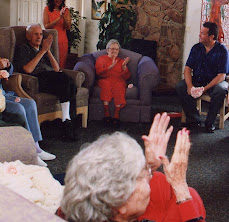
Rhythm is essential in performing and creating poetry with people living with memory loss. We often chant the poems using, "call and response," to engage the group. In this case "call and response," is where the session leaders says a line of poetry and has the group echo or repeat the line.

The NPR piece below, "How Rhythm Carries A Poem, From Head To Heart," gives a wonderful description of the importance of rhythm in poetry. The poet Edward Hirsch says, "Spoken-word poetry brings back that ancient feeling of poetry as performance and poetry as contest; and poetry as spoken, chanted, sung."

My background as a performance poet and my involvement with the Poetry Slam informs and guides my work as the founder of the Alzheimer's Poetry Project (APP). I trace many of the techniques and methods of the APP to lessons I learned in how to engage the audience as a performance poet. That ancient sense of poetry as performance is at the core of the APP.

One of the reasons "call and response," works so well with people living with memory loss, is that it taps into what neurologists call, auditory sense or echoic memory. In the book "Nueroscience," temporal categories of memory are defined in three classes:
1. Immediate memory
2. Working memory
3. Long-term memory

The book states, "The capacity of immediate memory is very large, each sensory modality, (visual, auditory, tactile and so on) appears to have its own semi-independent "memory register." Accessing immediate memory through the auditory sensory modality, we are able to engage in the performance of poetry. We find a high degree of success in asking them to repeat back words they have just heard and the rhythm along with rhyme help to facilitate the recitation.

Here is a joyful and playful example of "call and response," using lines from the EE Cumming poem, "I Carry Your Heart."

Wednesday, December 16, 2015

MEMORIES by Anne Keane

MEMORIES

It was a year ago,
or was it two,
that she first realized she forgot,
to remember:
Remember to remember,
she was going
to lose
weight
Fine
thinking
as the first.

shortly ago then
She can't remember.

It is her nightly medicine
or is it the month.
Did she ask you? Or forget to ask, did you
Answer or not
it is no longer always clear,
Though it seems not important to hold
On to forgetting
To remember
at times the sky blue and the clarity,
in a moment.

Saturday, December 27, 2014

Dementia Arts Research Article in the Washington Post


Fredrick Kunkle of the Washington Post asks, "Can Alzheimer’s be treated with the arts? Researchers aim to determine the answer."

Click here to read the full article.

The National Endowment for the Arts and the National Institutes of Health and others are pushing for more answers. At Birmingham Green, researchers from George Mason University are conducting a federally subsidized study to examine the impact of the arts on the emotional and cognitive health of older adults.

“There still needs to be a lot of work done,” said Sunil Iyengar, who heads the Office of Research and Analysis at the NEA. Iyengar said research into the effect of art on people with cognitive impairments has suffered from a lack of rigor.

Too many studies lacked proper controls, involved samples that were too small, and were poorly defined. They also may have been looking for the wrong thing, Iyengar said. While searching for hard evidence of biological improvements in memory or cognition, many also overlooked measurable improvements in the mood and well-being of people with Alzheimer’s, and their caregivers, too.

I am thrilled to be included in the article:

“But outside of these things is sheer joy,” said Gary Glazner, founder and executive director of the Alzheimer’s Poetry Project. Glazner said he was working at an adult day-care center in Northern California and searching for ways to connect with people with Alzheimer’s disease when he discovered the power of poetry to reach people with cognitive impairment.

Having studied poetry in college, Glazner shared Henry Wadsworth Longfellow’s poem “The Arrow and The Song” with a resident and from the first line — “I shot an arrow” — hit the mark. Glazner uses poetry, particularly beloved classics learned by older adults, in call-and-response with older people and guides them in writing poems. Jump-rope rhymes, even military cadences, can evoke responses from people with cognitive impairment that engage them, he said.

Monday, April 30, 2012

The Thing About Life

The Thing About Life
Elizabeth Raby
 
It's a strange thing about life--
how we want it, no matter what--
the cane, the hearing aid,
the oxygen pulled along behind us
like a grocery cart, which, of course,
it sort of is, feeding us our necessaries.
For the fortunate, the brain continues to function
at more or less its accustomed pace--
a little clog, a blockage here and there,
but we manage to work around them,
process and produce.  Through
my thicker lenses, around my
growing cataracts, I still am able to see
the hummingbird, iridescent green speck
riding purple-leaved branch of the plum tree
in early morning breeze. Behind them
 once again the sun clears the mountain.

Elizabeth Raby has been a poet in the schools for the Pennsylvania Council of the Arts, the New Jersey Council of the Arts, and the Geraldine R. Dodge Foundation. She taught poetry writing at Muhlenberg College.  Raby represented the Teachers for Tomorrow program as an English Teacher in Deva, Romania.  Her publications include The Hard Scent of Peonies, Jasper Press, Camphorwood, Nightshade Press, and Ten Degrees Above Zero, Jasper Press. She has lived in Santa Fe, New Mexico since 2001 where she and her husband run a monthly open poetry reading.  Raby is a member of the board of New Mexico Literary Arts and a Fellow of the Virginia Center for the Creative Arts.
More on Raby's books and poetry from Visual Artists Collective

Saturday, February 26, 2011

Poem in Harper's

Very excited to have this APP poem published by Harper's this month. Here is the link, hope you enjoy it!

Harper's Magazine

From “Sun,” a poem written by early-stage dementia patients during a workshop hosted by the Purchase, New York, chapter of the Alzheimer’s Association. Gary Glazner, a New York–based poet and founder of the Alzheimer’s Poetry Project, led the group in creating a poem about the sun, using Hone Tuwhare’s poem “Rain” as a model. The lines of the poem are comments by the participants in the original order.

Tuesday, January 4, 2011

IV


Our father died peaceful at home, with my brother Lon holding his hand, as dad took his last breath. On Christmas Eve we brought him to Kaiser hospital in Terra Linda and we spend the next three days at his bedside before they allowed us to take him home to die. The poem, “IV,” takes place during those days.

In going through our father’s papers I found a note he had written about growing up in Oklahoma.

“My earliest memories are of our farm in Blair. We lived in a two-room house. The ‘bathroom’ consisted of a one-hole out-house, and for Saturday nights, a large washtub. There were no kids living close by so I mostly played alone. My game of choice was pretending the tumbleweeds were cattle and I would chase them on a stick horse and rope them with a heavy cord. I would then drag them back to the barn and put them in the corral. With the Oklahoma wind always blowing this quite a job.”

IV
The morphine on your breath
Could make a grown man dizzy.

His hands on my shoulders,
he helps to lift himself up.
IV stand, maypole ribbons
of tube and power cord.
We step, step, stop,
step, step, steady,
our way to the toilet,
rolling the stand after us.
He can sit up on his own,
I give him a moment.
Snap on surgical gloves,
gently clean him.
Reverse our papa waltz,
lay him down to rest.

Trying to look busy,
listening for his death.

Sunday, January 2, 2011

Cutting Sign


Our father began his career in law enforcement as a Border Patrol agent in Texas in 1957. One story he tells about that time is how a Texas Ranger named Jim Nance traded his 44 Colt revolver for my toy pistol, putting it in my holster and letting me run up to my mother to show her my "new" gun.

This poem is based on the description my father told me about "cutting sign," the technique of Border Patrol agents use to track people.

Cutting Sign

You can tell a lot by how they walk.
If they’re lost, tired, scared,
the feet circle, drag, scatter.
You can tell their weight,
if they are a man, woman, or child.

Here’s a trick, sweep
a dry creek bed with a branch,
gives you fresh signs.
See how many you got.

If they have been walking in the sun,
short steps trace the heat right to them.
If they have been walking at night,
they break brush, unless there’s a moon.

Once, I saw the outline of knees
ground into the dirt
like crawling or praying.

Saturday, January 1, 2011

Can you Bake a Cherry Pie Billy Boy?


The Alzheimer's Poetry Project has its origins in part through my experience of using poetry in comforting my mother at the end of her life in 1997. This last week having the honor of being able to be at my father's bedside, again gave the chance to recite poetry to a dieing parent. The closing lines of Kubla Khan were especially powerful:

Weave a circle round him thrice,
And close your eyes with holy dread,
For he on honey-dew hath fed,
And drunk the milk of Paradise. 


I would sit at the head of my father's bed, softly saying the poem and connecting to him by matching his breathing with the cadence and rhythm of the words.

Below is a section from the opening essay in Sparking Memories: The Alzheimer's Poetry Project Anthology, it includes how my father and I used "Can you Bake a Cherry Pie," to comfort my mother.

Whenever I speak about the APP one question always comes up: “Do you have a family member with Alzheimer’s?” I do not, however I do have a personal connection to using these poems with a loved one. When I first began this project in 1997, my mother was in the last stages of terminal cancer. Through a combination of the drugs she was given to relieve the pain and the progression of the cancer she had grown unable to think and communicate clearly.
     
One day my father called to ask me to come over as my mother was having a particularly hard time. On arriving, I found her quite agitated. I had with me the poems from the Alzheimer’s program and I began to read to her and soon she was calm. Then my father Billy and I began to recite apoem that she had teased him with when they were childhood sweethearts. My mother quite gently began to say the poem along with us, even laughing as she joined in:

    Oh, where have you been Billy boy, Billy boy,
    Oh, where have you been, charming Billy?
    I have been to seek a wife, she’s the joy of my young life,
    She’s a young thing and cannot leave her mother.

    Can she make a cherry pie, Billy boy, Billy boy,
    Can she make a cherry pie, charming Billy?
    She can make a cherry pie, quick’s a cat can wink her eye,
    She’s a young thing and cannot leave her mother.


          It was one of her last moments of real clarity and a moment of playfulness that quite powerfully brought home to me how these poems could be of use to people.

Friday, December 31, 2010

Maps and Wings


Our father died yesterday at 2am. His obituary is below. On Christmas day when he was in the hospital I asked him if he wanted me to read him a poem and he asked for the one about "Okies."

I read it to him and he grinned and said "pretty good." Below is Maps and Wings written for my father. I will be writing more about him and his and my mother's connection to the Alzheimer's Poetry Project over the next few days. Gary Mex Glazner

Maps and Wings

The road looks the same
no matter where you are going.

Route 66 was my father’s road
and his father’s road.

Model A with the dust bowl
in the rear view mirror
and California in the headlights.

From being men to being Okies.
The vulgarities of newcomers.
A drowsy distant hope.

Route 66 was their plowshare.
They dug into the rank soil.
Held the miles in rusted fingers.

Maps folded like wings.
A banquet of motion.
Beckoning us now
with its broken fragments.

Let us piece the road together.
This is the way they went
and we shall follow them as we are able.

Billy Mex Glazner was born in Blair, Oklahoma on July 31st, 1930. His childhood sweetheart and wife of 47 years, Frankie Lou Glazner preceded him in death.

As a boy he worked picking cotton and experienced the Great Depression and the Dust Bowl. Like the characters described in John Steinbeck’s novel, “The Grapes of Wrath,” his family traveled from Oklahoma to California in search of work, where his father Mex found employment as an electrician on the Irvine Ranch. Billy’s middle name comes from the state of New Mexico where his grandfather worked on the railroad near Santa Fe. He was so enchanted by the land; he named his son after the state, who then passed it to his son and on to me as a family name. 

Everyone who knew Billy Mex remarked on his sense of humor and storytelling ability. Perhaps those talents had their origins in the fact his parents not only showed creativity with their unusual choice of a middle name, but in the fact that the given name on his birth certificate is Billy, not William.

He served in the Korean War as an artillery gunner. In 1957, he joined the U.S. Border Patrol in Sierra Blanca, Texas. He was promoted and transferred to work as an investigator in the Immigration and Naturalization Service (INS) in New York City in 1960. His 23-year career in law enforcement culminated in San Francisco as the Assistant Deputy Director, Investigations, INS in 1980. 

Upon his retirement in 1980 from the INS, he supported his wife in the purchase of Novato Florist and they worked together until their retirement in 1991. It takes a man secure in his masculinity to go from carrying a snub-nose, 38-caliber pistol in a shoulder holster and supervising INS agents to running a flower shop.

Recently he developed a passion for bowling and belonged to the Sons in Retirement Bowling League. 
His 1948, Blair Broncos high school yearbook lists his favorite food as: corn bread, molasses, and sassafras tea; his subject as Frankie; his song as “Cigarettes, Whiskey, and Wild, Wild, Women,” and his pastime as sleeping. His sister Ann reported that their mother Minnie was scandalized upon hearing these favorites
read aloud at his high school graduation and said, "He never drank sassafras tea."

He succumbed to cancer of the liver on December 30th, 2001. Billy Mex is survived by: his wife Ann; sisters, Sue and Ann; sons, Gary Mex, Kevin and Lon; their wives Margaret, Alma, and Jennifer, and grandchildren Jennifer, Emily, Frank, Beckett and Ruby. A memorial service will be held at the Presbyterian Chapel, 710 Wilson Ave. Novato, California, Sunday Jan 2nd, 2011 at 2pm.

Saturday, December 18, 2010

Marilyn

The poem Marilyn was created at the culminating event at the Orlando Art Musuem. A silde of the Andy Warhol print, which is in the collection of the museum was projected on the screen behind the stage and used as inspiration for the poem.


Marilyn

Where did you go Joe DiMaggio?
She was always growing.
JFK loved her.
When she died we all died.
We all loved her.
She had a crisp beauty.
She reminded us of spring.
She was a pioneer.
She was an original.
People looked at her beauty, but not her intellect.
She had an old, well-traveled soul.
She sang, “Happy birthday, Mr. President.”
She had everything, but was never happy.
She was full of light and shadow.
She overdosed on life. 

Here is the group creating the poem. 
Photos by Melixa Carbonell

Sunday, December 12, 2010

APP YouTube Channel


Check out the video at the Alzheimer's Poetry Project's new YouTube Channel:


This video was shot at Sterling Healthcare in Media, PA. The recognition of Sterling Healthcare’s unique programming include an award for creating a science club and their pet therapy dog, a spunky little Boston Terrier named Gilligan won a Bronze Medal for his therapy work from the American Kennel Club ACE Awards. It's an amazing well-run place!

More info at:

Thursday, November 25, 2010

Amanda Deutch on the Alzheimer's Poetry Project


Amanda Deutch is one of the APP's New York Poets, she speaks about her work with the APP and her father's Alzheimer's. This video is from a reading for the APP at the Community Bookstore in Brooklyn on Nov. 10th, 2010

Born and raised in New York City, Amanda Deutch is a poet who traveled the world only to return to the borough in which both of her parents were born. Amanda Deutch's work has been published widely in such magazines as Barrow Street, EOAGH, 6x6, Listenlight, Upstairs at Duroc and Full Metal Poem. She was the recipient of a Footpaths to Creativity residency in the Azores, Portugal and is a member of the Dusie Kollektiv and Rewords (www.rewords.blogspot.com). Her writing has been nominated for a Pushcart Prize and she has been invited to read in venues throughout the United States, Europe and North Africa. Deutch is the Founder and Creative Director of Parachute: The Coney Island Performance Festival in Coney Island as well as an arts organizer and educator. A former Counselor and Case Manager for at-risk youth in Portland, Oregon, she has designed and led poetry workshops for runaways, homeless teenagers, and adult cancer survivors. Whether hitting the pavement or inking the pen, Deutch dedicates herself to revealing the poetry everywhere.

Wednesday, October 27, 2010

Frances Kakugawa


Great article on Frances Kakugawa's book, "Breaking the Silence: A Caregiver’s Voice," by R. K. Singh on his blog at:

http://rksinghpoet.blogspot.com/2010/09/breaking-silence-tribute-to-sufferers.html

Singh writes, "...Kakugawa and her poet-colleagues’ varied experiences with a broad human perspective, engaging both mind and heart. The caregivers seek to share their compassionate spirit with a sense of gratitude to all those who help the victims of Alzheimer’s disease negotiate their mentally vacant existence."

More on Kakugawa, the book and her work here: http://www.francesk.org/homepage.html#top

Friday, May 21, 2010

More on Lee Chan-dong's film, "Poetry."


UPDATE- LEE CHANG-DONG'S POETRY WINS THE CANNES AWARD FOR BEST SCREENPLAY!

Here is a clip from Maggie Lee's review of the film in the Hollywood Reporter,

"Bottom Line: A disturbingly ambivalent view on art's relation to life and death.

CANNES -- Rhyming couplets, rather than religion, is the opium of an old lady beset by Alzheimer's and a family crisis in Lee Chan-dong's companion piece to "Secret Sunshine." While both films feature maternal figures whose lives are derailed by tragedies they cannot help, "Poetry's" tone and emotions are so painfully muted, its style so elliptical and Lee's exploration of the function of art in a morally vacuous society so ambivalent that it makes for extremely difficult and challenging viewing."

read the full review here http://www.hollywoodreporter.com/hr/film-reviews/poetry-film-review-1004092975.story

Poetry is now being touted as a possible winner of the Golden Palm award!
Michael Phillips of the Chicago Tribune calls the film one of his favorites and says, "The South Korean writer-director's protagonist is exceptionally rich: a 60ish grandmother coping with financial difficulties and the early stages of Alzheimer's."

More reviews on the film: Financial Times

Chicago Tribune

Huffington Poet

ABC News

Sunday, May 9, 2010

Alzheimer's Poetry Project in Philadelphia


Held our third training session in Philadelphia last week and one of the poets Sojourner Ahebee, wrote about the experience in her blog.

"Participating in the Alzheimer's Poetry Project allowed me to discover another way of encouraging my grandmother, who has Alzheimer's, to be creative. She loves this very long poem by Langston Hughes called The Negro Mother. I am so impressed by how much of it she has remembered and she beams when she recites it."

Here is a link to the full post-

http://trumpetworld.blogspot.com/

It was great working the Philadelphia poets including her mother!
Happy Mother's Day!

Tuesday, April 27, 2010

INDIAN MOTORCYCLE


INDIAN MOTORCYCLE
Jean C. Howard

When you sell
the Indian
I am away
in a hotel in Denver.
The news shoots
like electro shocks
through the mouths
of our family

Because when you sell
the Indian
despite the plead
my husband
made of you
before we left

Rumors of it running
through
as if we were losing
not just you
but the past of you
the boy running skinny
on the west side of Salt Lake

The you of you
that cried in boy terror
as great schoolmates
trailed your way

The slip of you
being bloodied at your
porch step
almost making it in

The almost of you
always
a dad that picks
you up and throws
you back out
to be man
to be a man
to be a man.

It is not the machine
we are losing
old and graced
still kicks up
in the garage

But the grace of you
sliding lightly across
the gym floor
arms adjusted
like tuned pistons
punching light
into your foe.

It is the blonde head
of you smashing waves
into the sky

The nuts and bolts
of you
greased and snarling
glistening gears
that ache for more.

It is the Zen of you
tight and tuned
and loose with liquor
kissing fear
right on its smacker

The girl of you
sewn tight in man-skin
mirrored by daughters
a fighting wife

The mother of you
curled like a brooch pin
within your gullet
her dirty housedress
her eyes of water
her breath still tinted
with hints of rose

When you sell
the Indian
you sell the promise
that you’ll go on

That thoughts won’t slip
by, silver trout
darting lightning
behind words

That you won’t wander
through the house
searching searching
all night long

Losing the “it”
of things,
of names and places
of checks your wrote.

When you sell the Indian
that which is precious
spokes and leather
aging chrome
still kicks up
deep in the garage

You forget that night.
With me, the daughter
frantically
trying to get it back.

Jean Howard was one of the original Slam poets in Chicago. She now lives in Salt Lake City and this poem reflects her experience with her father's Alzheimer's disease.
More about Jean on her website here http://www.jeanhoward.com/home.htm

Saturday, April 17, 2010

"Poetry," by Lee Chang-dong in Cannes Film Festival

The excerpt below on Lee Chang-dong new film is from HanCinema, Click to read the full report. This trailer is in Korean but it looks like an interesting film.


"Korean dramatic film "Poetry" is set to be released in France on August 25, according to the film's production company Uni-korea on Friday.

Uni-Korea announced through a press release that "Poetry", helmed by renowned director Lee Chang-dong, will be distributed by French distribution company Diaphana.

The movie, starring veteran actress Yoon Jung-hee, is about an elderly woman who takes poetry classes and writes her own poems while battling Alzheimer's disease.

"Poetry" has been chosen to compete at this year's prestigious Cannes Film Festival."

Thursday, April 8, 2010

Dementia Blog

Check out Susan Schultz' Dementia Blog.

Schultz writes "The Dementia Blog was written over the course of six months during the worst of my mother’s dementia. In August 2006 she was still in her home; by January 2007 she was settled into an Alzheimer’s home. The blog, like all blogs, moves backwards from the present into the past. Because it moves back, the reader has no sense of cause and effect and often does not recognize what has happened until reading further back. This form struck me as appropriate to a meditation on memory and self-loss."

It is a fascinating collections of images, including these poignant lines,"— The woman who is not wearing shoes comes up behind me and places her hands on my shoulders. She squeezes them. I turn and ask her name. She does not know."

Perhaps other people will or have used Schultz' to record their experiences in being a caregiver.

Tuesday, April 6, 2010

Thirty Seconds Before Dinner

Esther Altshul Helfgott's poem with its image of Harley-Davidson motorcycles, puts me in mind of the story from London about using replays of soccer, or what the rest of world calls football, to reach sports fans living with dementia.
Football Replay.

I love her image
"but this Harley flew
out of the picture frame
as if it were a bird."

You may read Esther's blog at Witnessing Alzheimer's

He was different tonight
more withdrawn
though he did raise his arm
when he saw a motorcycle
hanging on the wall.
You wouldn't expect
to see a Harley-Davidson
in a nursing home
but this Harley flew
out of the picture frame
as if it were a bird.
Abe was astonished,
even though his facial muscles
remained tight
and his mouth stayed closed.
For thirty seconds his eyes lit up.
Afterwards, we returned to where we were before:
me wondering what to do next,
he not waiting to go to dinner.

Sunday, March 28, 2010

APP poet Zoë Bird reports on Valentine Day at Sierra Vista, in Santa Fe


This was a special, short Valentine’s visit with the Dragonfly kids. On Monday, Feb. 8, we all got together and made valentines for the S.V. residents using recycled materials in the Sapling classroom; each of the 6 kids made 4 valentines for each of S.V.’s 24 residents. They were beautiful, and very touching; Helen, for example, made a valentine for Helen the elder reading, “Happy Valentine’s Day, Helen! I love you. I have the same name as you. Love, Helen!!!”

Actual delivery of the valentines on the 10th was really moving. Many of the residents were napping when we arrived, but the 6 kids presented their valentines to those who were present and the emotional reaction was tremendous. Residents were smiling, weeping and singing (Lupe sang, “America the Beautiful” and Frankie sang “Love Me Tender,” beautifully). The kids were shy at first, but warmed up with all the good feedback & seemed very happy about the visit. Molly (their teacher) & I were crying too!

Joel, an especially sweet and encouraging soul, seemed so overcome that I asked if I could give him a hug, and he accepted. I only got a chance to take a couple of photos, but the one with little Helen walking back from bestowing her valentine on a former kindergarten teacher shows something of the pride the kids felt & the level at which the residents were touched by our special “We love you” visit. Very, very special day.

Love me tender, love me sweet
Never let me go
You have made my life complete
And I love you so
Love me tender, love me true
All my dreams fulfill
For, my darling I love you
And I always will.

Love me tender- Ken Darby

Bright star, would I were steadfast as thou art--
...Not in lone splendour hung aloft the night
And watching, with eternal lids apart,
...Like nature's patient, sleepless Eremite,
The moving waters at their priestlike task
...Of pure ablution round earth's human shores,
Or gazing on the new soft fallen mask
...Of snow upon the mountains and the moors--
No--yet still steadfast, still unchangeable,
...Pillow'd upon my fair love's ripening breast,
To feel for ever its soft fall and swell,
...Awake for ever in a sweet unrest,
Still, still to hear her tender-taken breath,
...And so live ever--or else swoon to death.

.....Bright Star- John Keats