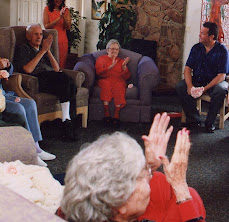
Thrilled to announce our publication in the Dec. 2023 issue of the peer-reviewed journal Arts and Health our paper Dementia Arts Mapping: observational methods for documenting impacts of poetry and recreation in care settings
Sunday, December 17, 2023
Thursday, April 2, 2020
APP Coronavirus Response
Do you know any kids or elders or cats or anyone really, stuck in the safety of their home? Please join poet Gary Glazner at 10:30am EDT each day, Monday through Friday, through April 10th
Call (339) 209-6482
Poetry for Life is a 15-minute long show that sounds like an old-fashioned radio show. Suitable for all ages! Funny Poems! Happy Poems! Poems that make you want to Dance. Love Poems! Silly Poems! Won’t you listen in and take a chance?
Contact poet Gary Glazner for more info at: garyglaznerpoet@gmail.com
Depending on the length of the PAUSE Quarantine and level of interest we may extend programing beyond the end date of April 10th.


Tuesday, August 13, 2019
I carry this luggage with me
I carry this luggage with me
- Norbert Góra
On the way from life
to death,
I carry this luggage
with me,
it gets heavier
with each passing year,
even short moments
want to put something in it.
I have children’s tears
packed there,
sleepless nights interrupted by
silent sobbing,
I have all the loves
that have gone away somewhere,
a bear and a bull market,
knowing that it was hard.
This luggage
is memories,
added to life for free,
sometimes they are like
outstretched wings,
sometimes they resemble
a ball at our feet.
I’m going ahead,
the next episode of my life,
I carry this luggage with me
to feel the magic of memories
again.
This poem comes to us from Poland.
The poet is Norbert Góra,
a former care assistant.

- Norbert Góra
On the way from life
to death,
I carry this luggage
with me,
it gets heavier
with each passing year,
even short moments
want to put something in it.
I have children’s tears
packed there,
sleepless nights interrupted by
silent sobbing,
I have all the loves
that have gone away somewhere,
a bear and a bull market,
knowing that it was hard.
This luggage
is memories,
added to life for free,
sometimes they are like
outstretched wings,
sometimes they resemble
a ball at our feet.
I’m going ahead,
the next episode of my life,
I carry this luggage with me
to feel the magic of memories
again.
This poem comes to us from Poland.
The poet is Norbert Góra,
a former care assistant.
Sunday, March 17, 2019
Gingivalis and Alzheimer's Disease

Also, pictured is Willa's dad and Cari's husband the artist Trent Edwards (to the far left). I know these long term friends not only through poetry and art, but Cari was also for many years my dental hygienist.
She has recently written and interesting essay on the connect between Gingivalis and Alzheimer's disease. The piece included a great story about Cari and Willa's time working with the APP.
Here is a link to her wonderful new blog "Ask My Hygienist"
Sunday, December 16, 2018
JAMA Article

The paper is a call for further research and ends with, “Reciting poetry is unlikely to change the progression of dementia, but it can help change the narrative of how unaffected individuals and society perceive dementia. Changing that narrative to include examples of creativity and moments of joy, and the tantalizing possibility that it can positively affect the consolidation of new short-term memories into long-term memories, alters the perception of dementia from an experience defined by isolation and lost personhood to one of social vitality and enduring personhood. This shift may help combat the stigma of memory loss and promote more humane and effective care environments and therapeutic strategies for working with these patients.
Here is a link to the JAMA essay
Tuesday, March 20, 2018
Arts in Medicine
Training Medical Students in the Use of Creative Expression to Improve Elder Care
"The poem springs from the half-spoken words of such patients as the physician sees from day to day… This, in the end, comes perhaps to be the occupation of the physician after a lifetime of careful listening." -William Carlos Williams
We are excited to announce that in July 2016, we launched the The Art and Medicine Program at the University Of Arizona College Of Medicine – Phoenix and the Alzheimer’s Poetry Project (APP), based in Brooklyn, New York, provided a series of participatory arts training workshops for medical students to use creativity with elder patients. We developed a medical student curriculum entitled, “Creativity in Elder Care,” for the Art in Medicine program. The program is now in its third year.
The workshops were co-taught by Gary Glazner, founder and Executive Director of the APP, and Cynthia A. Standley, PhD, professor in the Department of Bioethics and Medical Humanism at the University of Arizona College of Medicine – Phoenix.
Monday, January 9, 2017
AUTUMN IN LA
Autumn in LA doesn’t make sense,
shouldn’t even be a song.
I wouldn’t even give it a second thought
It starts on Christmas day
You know what I mean. I’d be a fool to run there.
Autumn in Brooklyn, leaves falling. They do.
Autumn in Vermont, a slight mist,
tramping through the forest
Autumn in LA sounds like fun and laughter
A cacophony of horns on the 405
Doesn’t sound different than any other month
Smells like smog
The kids go off to school. And we’re free!
The leaves change colors in autumn
in New York, weather cooling down
We don’t have that here
But the coloring of my liquidambar trees
And there’s a fragrance to it. Autumn.
There’s a street that has a tunnel of trees
They all turn, it’s a very pretty street
Nobody can afford to live on it
but it’s a very pretty street
Autumn in New York makes sense.
Autumn in LA doesn’t make sense.
Created by poet Sarah Jacobus, with the poets at OPICA. Sarah writes about the process, "I chose an autumn theme for today, despite the fact that it’s over 90 degrees here. I gave each participant a little pumpkin to hold, feel, smell. We did call and response with the first verse of James Whitcomb Riley’s The Frost is on the Punkin and made some vigorous kyoucks and gobbles and clucks. A woman in the group started humming Turkey in the Straw, and we realized we could sing the poem to that tune. So we did. Then we listened to Sarah Vaughan’s arrangement of Autumn in New York and talked about songs as poems."
Wednesday, July 6, 2016
RIP Pat Summitt

Jenkins gets the idea from an unnamed Alzheimer’s guide that suggests using poetry with people living with memory loss and the Longfellow poem that opens, “I shot an arrow into the air.” That is my story and the Alzheimer’s Poetry Project is the unnamed guide. Jenkins writes, “After she was forced to retire, reading to her became harder as the disease progressed. One afternoon I followed the advice in the Alzheimer’s guide and tried a short poem. I read about Longfellow’s arrow, streaking through the air and coming down he knew not where, ‘For who has sight so keen and strong that it can follow the flight of song.’”
Jenkins goes on to use Mary Karr’s amazing poem, “Loony Bin Basketball.” That I had any small part in these two friends connecting through poetry is an honor.
Much love to the family, friends and fans of Coach Summitt.
Wednesday, May 11, 2016
Nurses Day
(By the Avalon Poets on 5/6/16 with past Poet Laureate of Madison, Fabu Carter)
I still am a nurse. Once a nurse, always a nurse.
I have such a pain in my neck. I need a nurse.
Nurses are kind; helping people recover from whatever is bothering them.
Nurses are very nice people to work with.
I love nurses.
Nurses are for us. They look after us.
I enjoyed teaching, but nursing is something else.
The noble profession of nurses.
I’m happy its National Nurses Month, week and day.
I’d like to be a nurse.
I always wanted to be a nurse and have someone call “Nurse, Nurse!”
Tuesday, March 8, 2016
Imagine That- Sarah Jacobus


One of the pleasures of running the Alzheimer's Poetry Project (APP)
is the people you meet.
Sarah Jacobus has been taking the the APP on-line training
and it is true delight to see how she is shaping the APP to her own voice and vision.
In addition, Jacobus has been certified in the storytelling project, "TimeSlips,"
and is taking an improv class!
The poems she has been creating with her groups in Los Angeles are full of strong images.
This is a photo Sarah took of a budding peach tree in her backyard.
She brought clipping from the tree to share with and inspire her group.
She asked a series of questions around the theme of trees
and the group's answers became the lines of the poem.
I can't wait to see what her and her poets come up with next.
It is an honor to share their poem with you.
I AM A TREE
(The poem “I Am a Tree,” inspired by the Joyce Kilmer poem “Trees,”
was created with Sarah Jacobus by the poets at OPICA,
a Los Angeles adult day program and counseling center for people with memory loss.)
I have a strong central bark
and branches with flowers at the end
I am mostly green
a little brown at the tips
but mostly green, that’s for sure
I am brown, solid and gray
with little touches of red and blue
Fragrance clean
I smell like sweet apple
I shade myself from being frightened
Refreshing, I smell the air in the neighborhood
It keeps me from thinking of bad things
Refreshing, and raring to go explore the area
maybe a deer, or a small squirrel there
a brook with stones that are smooth
smooth
They make a person feel real good about life.
We had an elm tree in the backyard
There was another tree like it
3,000 miles away in Connecticut
It had the same fragrance
I could jump back and forth between them
I sit at the top of a windy hill and feel
nostalgic about an old memory
I’m a tree that hides me from the world
and lets me think about
who I am
who I want to be
What a memory
Sarah Jacobus, LCSW, MFA, is a Los Angeles social worker with a Master of Fine Arts Degree in creative writing. She is committed to creative engagement for elders with memory loss as a tool for meaningful self-expression, community building and fun. Trained and certified by APP founder Gary Glazner, she is currently bringing the APP method to senior centers, care communities and individuals in Los Angeles County
Learn more about Sarah’s work at www.imaginethat.la
Friday, February 19, 2016
APP on Wisconsin Public Radio

Please give the show a listen:Poetry And Alzheimer's
The Wisconsin Alzheimer's Disease Research Center is a unique program combining academic, clinical, and research expertise from the University of Wisconsin-Madison School of Medicine and Public Health and the Geriatric Research, Education, and Clinical Center (GRECC) of the William S. Middleton Memorial Veterans Hospital in Madison, Wisconsin.
For Our Elders With Memory Loss
by Fabu Carter
(From Dementia Arts: Celebrating Creative in Elder Care)
Some call you seniors
I call you wise elders
Living long and learning much.
You should be honored
Your grey hair a symbol
Of victory and authority in life.
When your memory flees or hides
And every face seem strange
Remember the other signs of love.
The gentle touch, the kind voice
The spirit that welcomes you
Just as you are.
Reassure yourselves
That you know how love feels
For it will chase the fear of forgetting
away.
Sunday, January 31, 2016
Rhythm of Poetry
Rhythm is essential in performing and creating poetry with people living with memory loss. We often chant the poems using, "call and response," to engage the group. In this case "call and response," is where the session leaders says a line of poetry and has the group echo or repeat the line.
The NPR piece below, "How Rhythm Carries A Poem, From Head To Heart," gives a wonderful description of the importance of rhythm in poetry. The poet Edward Hirsch says, "Spoken-word poetry brings back that ancient feeling of poetry as performance and poetry as contest; and poetry as spoken, chanted, sung."
My background as a performance poet and my involvement with the Poetry Slam informs and guides my work as the founder of the Alzheimer's Poetry Project (APP). I trace many of the techniques and methods of the APP to lessons I learned in how to engage the audience as a performance poet. That ancient sense of poetry as performance is at the core of the APP.
One of the reasons "call and response," works so well with people living with memory loss, is that it taps into what neurologists call, auditory sense or echoic memory. In the book "Nueroscience," temporal categories of memory are defined in three classes:
1. Immediate memory
2. Working memory
3. Long-term memory
The book states, "The capacity of immediate memory is very large, each sensory modality, (visual, auditory, tactile and so on) appears to have its own semi-independent "memory register." Accessing immediate memory through the auditory sensory modality, we are able to engage in the performance of poetry. We find a high degree of success in asking them to repeat back words they have just heard and the rhythm along with rhyme help to facilitate the recitation.
Here is a joyful and playful example of "call and response," using lines from the EE Cumming poem, "I Carry Your Heart."
Sunday, January 17, 2016
Found+Art=Found+Poetry

Seeing the way he used found objects to create a number of the sculptures, made me think that how we create poems in the Alzheimer's Poetry Project (APP) could be described as "Found Poetry."
Here is a guide to the exhibit that gives examples of how Picasso used found objects.
Wikipedia defines, "Found poetry as a type of poetry created by taking words, phrases, and sometimes whole passages from other sources and reframing them as poetry (a literary equivalent of a collage) by making changes in spacing and lines, or by adding or deleting text, thus imparting new meaning."
The main technique we use with APP to create poems is by asking open-ended questions around a theme. For example at the John Michael Kohler Art Center in Wisconsin with a group from the Gathering Place, we created the poem "Ocean." The poem was inspired by Tristin Lowe's artwork of a life-sized whale, "Mocha Dick." We asked what the ocean would smell, taste, look, sound, and feel like. We imagined encounters with whales. We wrote down all the comments from the group, taking care to transcribe as close to the actual words as possible and then we shaped that text into a poem.
We started the session by performing: "Catch a Little Rhyme," by Eve Merriam; "Whopper!" by Jack Prelutsky; "The Whale," by Hilaire Belloc and sections of "The World below the Brine," by Walt Whitman; and "Moby Dick," by Herman Melville. These poems also helped to inspire our original poem.
When we perform the newly created poem with it's "found" text we use a "call and response," technique to perform the poem with the group and improvise, thinking of the lines in a similar way to how jazz musicians interpret a melody, changing among other elements, the tone, rhythm, and speed of the recitation. We are always being open to the group adding new lines, as you see at the end of the poem, with the improvisation on whale, pail and ale.
Another artist we draw inspiration from is Robert Rauschenberg’s work with Combines. This mixing of media and breaking down of boundaries between painting and sculpture also guides our work in partnering with assisted living, adult day care, senior centers and cultural organizations including museums, to provide programming for their clients, we have a group of ready, willing and able people who respond strongly to the opportunity to express their creativity, with the goal of giving voice to people living with memory loss.

Mocha Dick, which appears in the video courtesy of the artist in collaboration with the Fabric Workshop, The West Collection, and Fleisher/Ollman Gallery, PA and John Michael Kohler Art Center. Mocha Dick is the real life whale that Melville based "Moby Dick," on.
Special thanks to Margaret Groff, Education Program Manager at JMKAC and Cindy Musial, past Director at The Gathering Place for setting up the workshop.
Wednesday, December 16, 2015
MEMORIES by Anne Keane
MEMORIES
It was a year ago,
or was it two,
that she first realized she forgot,
to remember:
Remember to remember,
she was going
to lose
weight
Fine
thinking
as the first.
shortly ago then
She can't remember.
It is her nightly medicine
or is it the month.
Did she ask you? Or forget to ask, did you
Answer or not
it is no longer always clear,
Though it seems not important to hold
On to forgetting
To remember
at times the sky blue and the clarity,
in a moment.
Monday, July 27, 2015
RIP Richard Taylor...Hello My Name is Richard

The speakers in addition to Richard and the Senator among others included: Rocco Landesman, Chairman, National Endowment for the Arts; the Guest Poet, Stuart Hall who read poems about living with memory loss; Sunil Iyengar, Director of Research and Analysis, National Endowment for the Arts; Dr. Anne Basting, Executive Director, Center on Age & Community and founder, TimeSlips; Maria Genné, founder, KAIROS ALIVE! and Margery Pabst, Executive Director, Pabst Charitable Foundation for the Arts and author of “Enrich Your Caregiving Journey."
All of them were well spoken and articulate about memory loss and care-giving but it was Richard who brought the issue to life and who made the standing room crowd of Senate staffers and the public laugh and cry. So many of the people who attended the panel briefing on the state of Dementia Arts Research came up after the event and talked about how moving Richard's talk was.
I first met Richard at an Alzheimer's Foundation of America Conference in Dallas in 2006. It was the first time I had attended a conference on Alzheimer's where a person living with memory loss had spoken at the conference. Richard always pushed for including that voice. When I began organizing Dementia Arts on Capitol Hill, it was my great hope he would be able to attend and I organized the event around him.
When I first contacted Richard about speaking at the event, he knew I would need sponsors and he said, "Are you sure you want me? You know I can be considered quite controversial." As Richard predicted, when I was talking with a marketing person for one of the major Alzheimer's advocacy groups, the person asked about the speakers at the event and said, "You know Richard Taylor called me an angel of death." We talked it through and agreed that if we were living with memory loss, we might also have Richard's sense of urgency and frustration, at how most if not all the resources and funds raised around Alzheimer's, are put to use for a distant cure and not towards helping people today.
In the end, the Alzheimer's advocacy group, did help us to promote and get the word out about the event. I believe that although was difficult, that it helped the person to talk out how it felt to be described that way. The conversation was frank and honest and Richard loved hearing the story. I think this person's anger came in part from the guilt of knowing we really don't do enough. I know for myself that when I heard Richard speak, it always pushed me to work harder for people living with memory loss.
Below are a few of the remarks he made that day, shaped into a poem. Like so many people I am missing my friend Richard today, but take heart in his words and send to his family and all his friends thoughts of love.
Hello, My Name is Richard Taylor
It’s not complicated
understanding who I am
once you get past the stigmas.
I am Richard,
a whole human being
living with the disabilities
associated with the symptoms
of Dementia.
Please do not give up on me
when I do not voluntarily
communicate as you.
Assume the best
for me, and in me.
Speak to me
as if I am all here.
It is a moral imperative
to support those who
for no reason
of their own cannot
meet their own needs.
A clean bed, a warm meal,
surroundings that mimic a hotel-
these are the basic needs.
It is the higher level needs
you all best support.
The needs that bring a smile
to my face, a bounce to my step,
and a handshake, a hug, or a kiss
for you when you leave.
Hello, my name is Richard Taylor;
I am a retired psychologist
living with the symptoms
and diagnosis of Dementia,
probably of the Alzheimer’s type.
Why is it everyone
is so amazed when we
dance, sing, and write?
Could it be we have been
hitherto written off as being fully human?
As our symptoms increase
do our needs for happiness,
connectedness, friendship,
self-esteem decrease?
Of course not.
I will be a complete
human being until
about two minutes
after I have drawn
my last breath.
Friday, February 20, 2015
APP in Wisconsin on local TV
This event was made possible by Bader Philanthropies’ funding, formerly the Helen Bader Foundation and a leader in the fight against Alzheimer’s disease throughout Wisconsin. Big thanks to all the students at Altoona High School and their wonderful teacher Angela Roloson. Thanks also to Ella Shaw teacher extraordinaire, who organized the events and to her students at Durand High School.
Thursday, January 22, 2015
Poetry for Life

Presented in the round
I used language like keys
And love is what I found
Love for the now and for history
And the love was unlocked
With the key of poetry
- Jalen Bell
So excited with get to work with talented Jalen Bell, the 2014 Poetry Out Loud, Arkansas State Champion and his family! He wrote that wonderful poem after our poetry session on Tuesday performing and creating poems with the people at Innisfree Senior Living Community in Rogers.
His younger sister Jaden also participated in the session as did his father Donovan. Jaden is preparing to take part in the National Spelling Bee. When I asked about her favorite word to spell, she said Pfeffernuesse, the German Christmas cookie. As soon as she replied one of the men in the group jumped up, went to his room and brought back a Pfeffernuesse! It was delicious!
Yes we also read the patron poem of the home, "The Lake Isle of Innisfree." The event was hosted by the Arkansas Arts Council. Big thanks to Cynthia Haas the Arts in Education Program Manager.
Poetry for Life is a pilot project to bring students who are participating in Poetry Out Loud to assisted living, adult day care and senior centers to perform and create poems with the elders.
Saturday, December 27, 2014
Dementia Arts Research Article in the Washington Post

Click here to read the full article.
The National Endowment for the Arts and the National Institutes of Health and others are pushing for more answers. At Birmingham Green, researchers from George Mason University are conducting a federally subsidized study to examine the impact of the arts on the emotional and cognitive health of older adults.
“There still needs to be a lot of work done,” said Sunil Iyengar, who heads the Office of Research and Analysis at the NEA. Iyengar said research into the effect of art on people with cognitive impairments has suffered from a lack of rigor.
Too many studies lacked proper controls, involved samples that were too small, and were poorly defined. They also may have been looking for the wrong thing, Iyengar said. While searching for hard evidence of biological improvements in memory or cognition, many also overlooked measurable improvements in the mood and well-being of people with Alzheimer’s, and their caregivers, too.
I am thrilled to be included in the article:
“But outside of these things is sheer joy,” said Gary Glazner, founder and executive director of the Alzheimer’s Poetry Project. Glazner said he was working at an adult day-care center in Northern California and searching for ways to connect with people with Alzheimer’s disease when he discovered the power of poetry to reach people with cognitive impairment.
Having studied poetry in college, Glazner shared Henry Wadsworth Longfellow’s poem “The Arrow and The Song” with a resident and from the first line — “I shot an arrow” — hit the mark. Glazner uses poetry, particularly beloved classics learned by older adults, in call-and-response with older people and guides them in writing poems. Jump-rope rhymes, even military cadences, can evoke responses from people with cognitive impairment that engage them, he said.
Thursday, November 13, 2014
Memory Arts Cafe Holiday Party

New York Memory Center
199 14th Street, (At 4th Ave.) Take the R to Prospect Avenue
This special holiday season Memory Arts Café will highlight
the artists of the New York Memory Center. Meet new friends and greet
old ones as we ring in the holidays with laughter, toasts and cheer.
Poet-in-Residence Gary Glazner will host the evenings entertainment.
Monday, November 10, 2014
NEA Audio Piece on the APP

Subscribe to:
Posts (Atom)